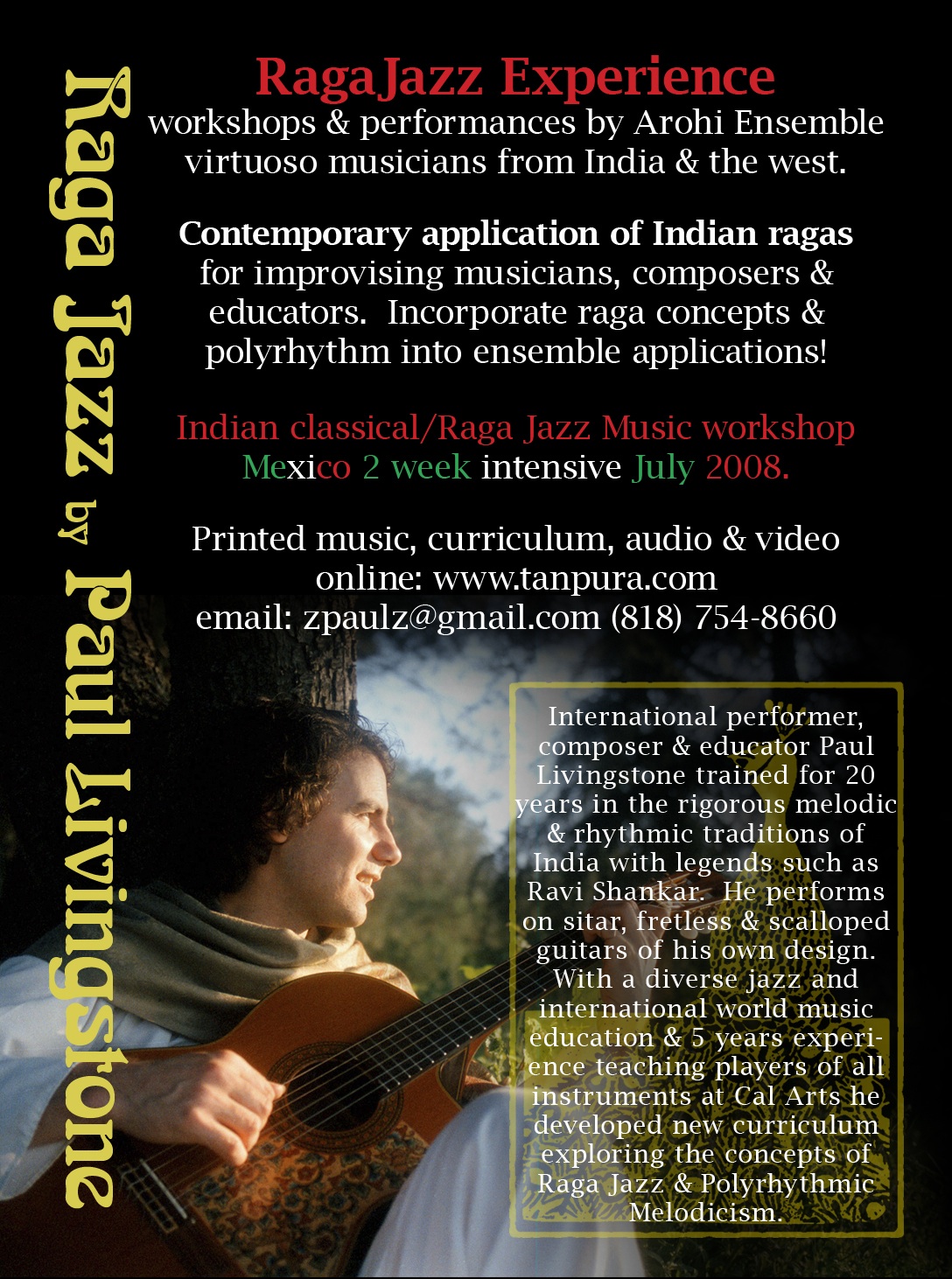
RagaJazzMusic is publishing content including music workbooks, music charts for study of classical Indian music as well as contemporary applications to creative and crossover world music.
We are now offering a series of free videos called, 'Exploring Ragas & Rhythms' for western musicians of any style to learn and apply concepts of Indian music to their own work. Here's the first of the three videos, check it out and make some comments or ask questions on the You Tube video.
Join our new RagaJazzMusic (for musicians) Facebook page here too, you'll find additional video links, tips and conversations about this work to encourage and further your study!
We've been getting great feedback from the first introudctory video, two more coming your way shortly and then look out for out Ragas & Rhythms Pro (Online Course) to launch this winter.
Our first publication SITAR TALIM, is a complete sylabus for sitar in the style of our guru the maestro Pandit Ravi Shankar. Order the book here on Cafe Press.
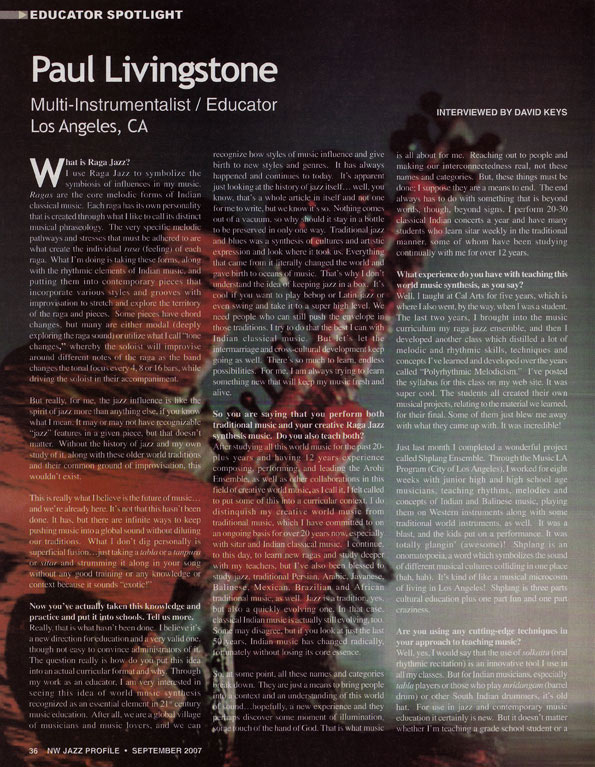
What is Raga Jazz?
I use Raga Jazz to symbolize the symbiosis of influences
in my music. Ragas are the core melodic forms of Indian
classical music. Each raga has it's own personality that
is created through what I like to call it's distinct musical
phraseology. The very specific melodic pathways &
stresses that must be adhered to are what creates the
individual rasa (feeling) of each raga. What I'm doing
is taking these forms, along with the rhythmic elements
of Indian music, and putting them into contemporary pieces
that incorporate various styles & grooves with improvisation
to stretch and explore the territory of the raga &
pieces. Some pieces have chord changes, but many are either
modal (deeply exploring the raga sound) or utilize what
I call tone changes, whereby the soloist will improvise
around different notes of the raga as the band changes
the tonal focus every 4, 8 or 16 bars, while driving the
soloist in their accompaniment.
But really for me the jazz influence is like the spirit
of jazz more than anything else if you know what I mean…
it may or may not have recognizable 'jazz' features in
a given piece but that doesn't matter. Without the history
of jazz and my own study of it, along with these older
world traditions and their common ground of improvisation,
this wouldn't exist.
This is really what I believe is the future of music…
and we're already here. It's not that this hasn't been
done, it has, but there are infinite ways to keep pushing
music into a global sound without diluting our traditions.
What I don't dig personally is superficial fusion, just
taking a tabla or a tanpura or sitar and strumming it
along in your song without any good training or any knowledge
or context because it sounds 'exotic'!
Listen to our most recent ragajazz chamber music here form the new Arohi 'Ahimsa' record.
Why a global music program for High School students?
A program of this nature represents a new paradigm in music education.In the most diverse city
in the world this is a time to empower music students with a program that truly reflects our
own demographics and cultural heritage.
A cutting edge performing arts program with a global music program would emphasize a curriculum that
educates and empowers our identity as a globalized city and the melting pot and immigrant
experience that is Los Angeles.
Our students are thus prepared to be thoughtful,sensitive and creative citizens and 21st century
artists of the world.
Pedagogy (Contemporary Applications of World & Crossover Music)
I am a music educator who has worked diligently in developing and implementing a
curriculum that reflects the cultural makeup of our city as a microcosm of the world.
Through an appreciation and understanding of the vital traditions of western music
combined with a vista of international forms I believe that our youth will begin to
see music making as a bridge to uniting cultures as global citizens in the 21st century.
My interest in developing a program for the music department of this extraordinary new
school downtown stems from my commitment to creative arts communities and
specifically to innovative music making and critical artistic thinking from a global
perspective. I have dedicated the majority of my life to music education and the major
theme in my work has been exploring our collective identity through the cultural tapestry
of musical artistry in Los Angeles. My career has been stimulated by travel since my
youth, originally as a student, then as a performer, composer and educator through the
United States, Europe, India, South East Asia and Latin America.
I feel that a global approach is essential to a 21st century music education. Providing a
comprehensive cross-cultural model alongside a solid and lively western music education
will soon be expected from truly progressive arts programs. Students emerging from
such an experience, having been exposed to and trained in such a diversity of musical
frameworks will have an enriched worldview that informs all their further endeavors.